

We Can't Coddle Kids to Greatness
There is a kind of difficulty that has gotten a bad name it does not deserve. Not pain, not suffering, but exertion: the strain of reaching for something just past what you can already do. That exertion is not the thing blocking a student from learning. It is the best pathway toward learning, and we have spent years engineering it out of the classroom.

Optimization Isn't Always Optimal
Optimization is not the problem. AI tutors, project-based learning, critical thinking frameworks, and inquiry-based curricula all work when the foundation underneath them is built. When a student has not automated multiplication, decoding, and basic sequencing, working memory is already at capacity before the advanced strategy begins. The strategy is not failing. The sequence is.

Interview with the author
"The premise I start from is that the hardware is not broken. A neurodivergent brain is a difference in biological architecture, not a defect. So the question I want teachers to stop asking is 'What is wrong with this child?' The better question is 'What does this nervous system need in order to function?' That reframe changes everything that follows, because it moves the intervention from the child to the environment."
J. Daniels, on Adjusting the Dials
The ROUNDOFF PAYOFF
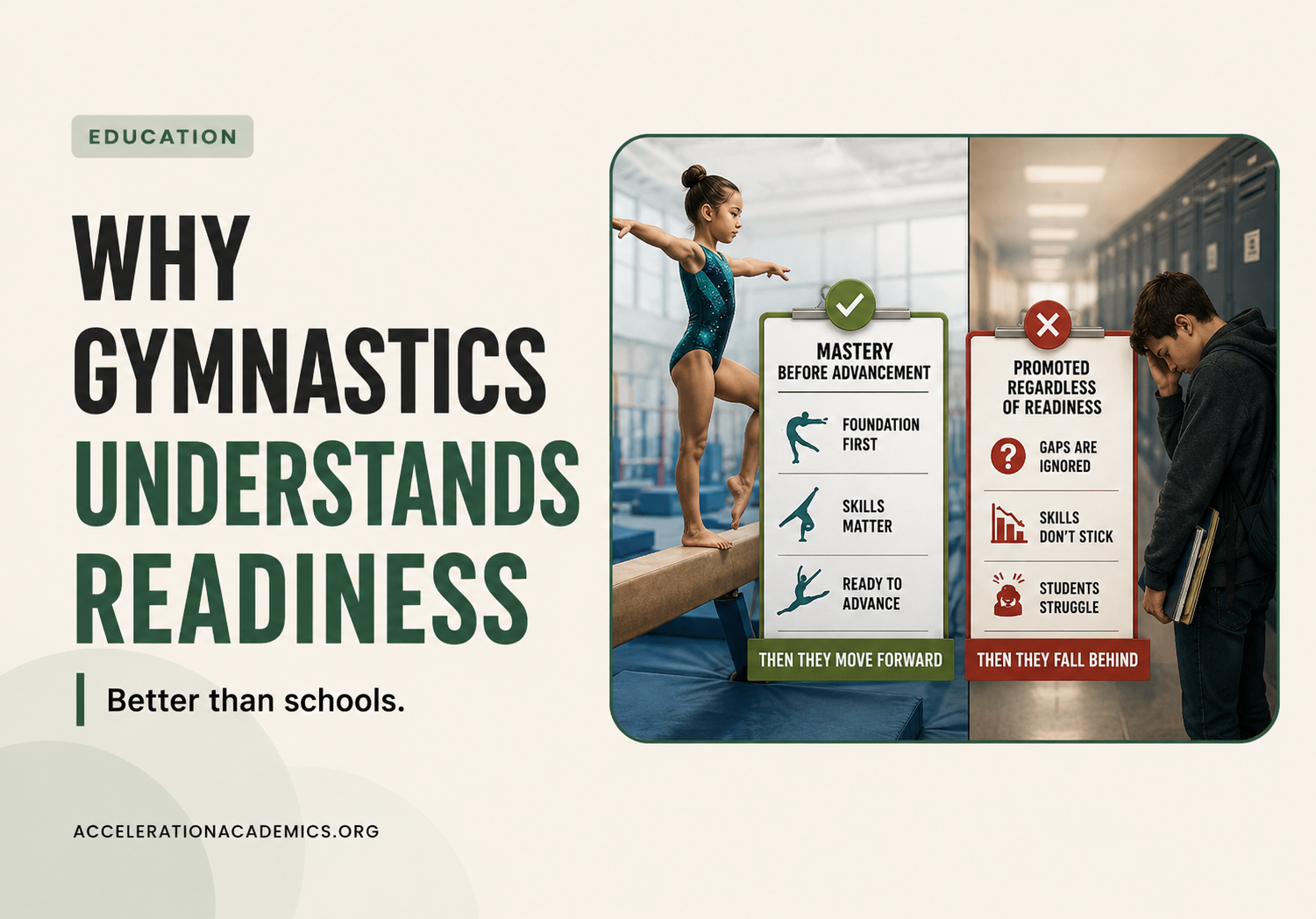
The foundation is never the flashy part. The round-off does not get the applause. The back handspring does. But every skill that follows in the sequence is a product of what the round-off generated. Schools make the same mistake: they diagnose failure at the level where it became visible, not at the level where it started. The algebra problem has a history in arithmetic. The geometry problem has a history in algebra. Mastery-based progression does not eliminate difficulty. It finds the right level and addresses it there.

The Case for the 3-hour School Day
Transitions and off-task time erode between 10 and 30 percent of potential learning time in a typical school day. Massachusetts added 300 instructional hours across 26 schools and found no measurable impact in math, reading, or science. The evidence is consistent: quality of instruction is the most significant in-school factor driving student achievement. Not seat time. Not hours. Quality.